On Bending Time
Crip Time and (Dis)abled Epistemologies

Crip Time is a concept exploring how people living with disabilities truly bend the clock to meet their bodies, as opposed to adhering to the limitations of a linear concept of time. Crip Time honours people living with disabilities and chronic illnesses as almost a location through which we can better understand how time can bend and shape.
It makes me think of the surrealist artwork by Salvador Dali below. The work has been speculated by many Art Historians as being inspired by Einstein’s theory of special relativity – the idea that time is not a universal constant in the way it was once thought to be. The melting clocks representative of our previous concepts of Newtonian time, melting away with this understanding of the relativity of time. The coalescence of Physics, Art, and, with Crip Time, Disability Theory.
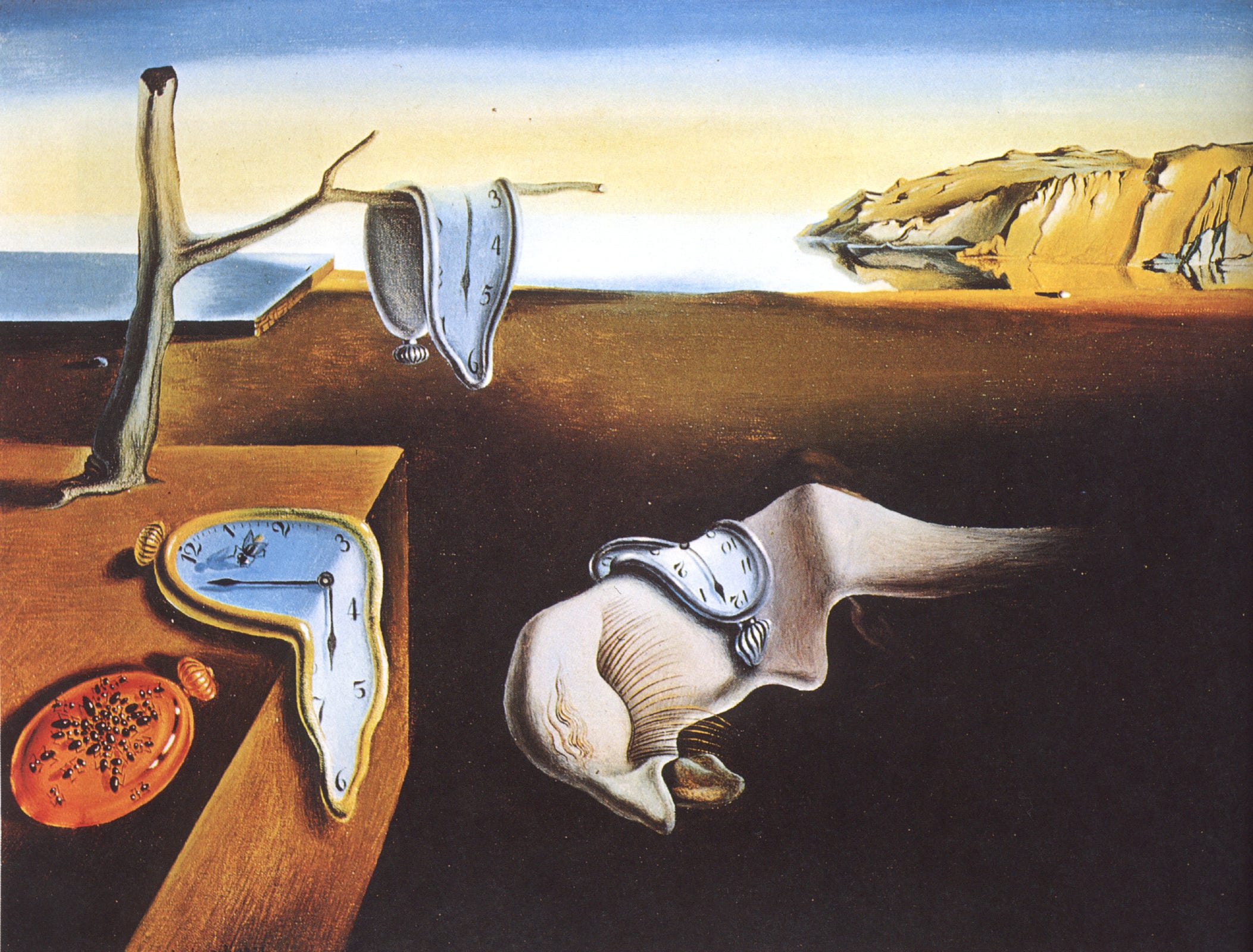
Salvador Dali - The Persistence of Memory
What interests me most is not what people living with disabilities can or cannot do. Nor the desire to extend time so that disabled people can do ‘more’. Instead, it is the presence we hold for what is. The deep presence in which we do not try to force different body/minds to adhere to a linear system of time and space, and discipline these body/minds into the dominant culture. Instead, what might we learn from these locations? How might we better extend our collective imagination through witnessing the lived realities of those that are marginalised and how they relate to time. There is deep epistemic value in the phenomenological realities of disabled people. And, as opposed to, trying to mould people to fit into the dominant culture – it is a far greater and more alive experience for us all to gather knowledge from the margins. To understand how those who live a different reality can teach us more challenging lessons about our collective reality – and in this case it is our collective relationship to the sociality of time.
In keeping with Crip Time, my body is tired today and so I will not pour on to the page in the way I intended to. Instead, I want to leave you with some quotes from some of my favourite articles exploring this concept. Perhaps this is an even more fitting way to share this knowledge. In future, I will write more deeply about how this understanding of time might be thought through various lenses to better understand our social realities – but that time is not now. But I trust it will be at the perfect moment, in the same way through this lens of Crip Time we might not see disabled people ever as late because fundamentally time bends and shifts and continually transforms.
Six Ways of Looking at Crip Time
Ellen Samuels
My friend Alison Kafer says that "rather than bend disabled bodies and minds to meet the clock, crip time bends the clock to meet disabled bodies and minds." I have embraced this beautiful notion for many years, living within the embrace of a crip time that lets me define my own "normal."
Crip time is time travel. Disability and illness have the power to extract us from linear, progressive time with its normative life stages and cast us into a wormhole of backward and forward acceleration, jerky stops and starts, tedious intervals and abrupt endings. Some of us contend with the impairments of old age while still young; some of us are treated like children no matter how old we get. The medical language of illness tries to reimpose the linear, speaking in terms of the chronic, the progressive, and the terminal, of relapses and stages. But we who occupy the bodies of crip time know that we are never linear, and we rage silently—or not so silently—at the calm straightforwardness of those who live in the sheltered space of normative time.
Crip time is grief time. It is a time of loss, and of the crushing undertow that accompanies loss. I lost my mother when I was twenty and she was fifty-two, to a cancer that she had lived with for fifteen years. But those numbers don't say anything about the way the days slowed and swelled unbearably around her death, or how the years piled up afterward, always too much, never enough.
For crip time is broken time. It requires us to break in our bodies and minds to new rhythms, new patterns of thinking and feeling and moving through the world. It forces us to take breaks, even when we don't want to, even when we want to keep going, to move ahead. It insists that we listen to our bodyminds so closely, so attentively, in a culture that tells us to divide the two and push the body away from us while also pushing it beyond its limits. Crip time means listening to the broken languages of our bodies, translating them, honoring their words.
A Decolonial Feminist Epistemology of the Bed: A Compendium Incomplete of Sick and Disabled Queer Brown Femme Bodies of Knowledge
Tala Khanmalek and Heidi Andrea Restrepo Rhodes
Here we lift up the bed as not only a visionary site of political organizing but also a site of building community within and against the push to dispose of each other. The lived experience of bedlife has been our point of connection and profoundly shaped the ways we work together. We write as comrades- in- bed to affi rm and advance our interdependence. We thus foreground the fact that we are members of each other’s “care webs” who necessarily risk vulnerability in an eff ort to cultivate belonging between us.”
The healing potential in imagining forms of loving that exceed the body and its
material limitations when rendered immobile through illness- as- disability.
How the bed becomes the vessel from which a certain kind of “world”- travelling is made possible. Bedlife also refuses to see chronically sick or disabled forms of existence as lacking in agency— as bodies who have been merely confined to the bed: the bed is not our end
Many of us organize from bed, write from bed, love each other across thousands of miles
from bed, and live a whole lot of life from it in the face of inadequate systems of medicine and care, which have often failed to support us in thriving how we might otherwise want to thrive.
For me, dreamwork foregrounds how our “irrational” bodies, our bodies disinclined to cooperate, our unruly bodies, can create and know in the subcutaneous and submarine. Dreamwork reconfigures what it is to know, turning past, present, and future, the grip of settler colonial and capitalist temporality, in and over upon itself, tearing its fabric. Dreamwork feels like a refusal of positivist knowledge production, a tapping into what exceeds the body, a process both of envisioning and revisioning.